
Get your rosettes here! Nice fine rosettes!
Welcome to you and your family. We sell the best rosettes in all the Shire! We use the finest ribbons, and our designs come from all over Arda.


We are the only hobbit vendors to have exotic rosettes from beyond the Shire!
For more information, browse: The Shire -- Old Forest -- Lothórien -- Rohan -- Ithilien
Featured rosettes:
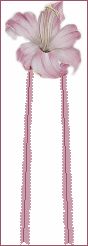
Belladonna – buy one to remember Bilbo’s amazing mother

Camellia – this exotic flower does not come from the Shire but comes from the Far East. Live dangerously, buy a camellia rosette.

Daisy – Our Rohirrim friends call the daisy, daes eage/ daes eaye or "day’s eye" because daisies open and close with the sun. Daisies represent childhood innocence and are associated with modesty, purity, and gentleness. Maids wanting to know if their chosen one loves them pluck the petals of daisies saying, "he loves me, he loves me not." We do not suggest you do this to your rosette.
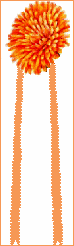

Marigold, Pot – these symbolize enduring love. Buy one to show your love. Marigolds are also associated with the sun and pot marigolds open and close with the sun like daisies. Big Folk say the name comes from "Mary’s gold" and so have an association with the Valar named Varda. The flowers are good in the pot, too.

Mushroom – mushrooms aren’t flowers, but they are so tasty, they should be! Our mushroom rosettes picture the best from the Marish.

Nasturtian – a favorite in hobbit gardens, even though they have a pungeunt smell which we have not duplicated. But they are pretty, are they not?
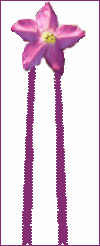

Nicotiana/ Pipe weed – hobbits are justly proud of their pipe weed, but the flowers and pretty too. Hobbits are the ones who realized it might be a good idea to smoke the pleasantly scented plant, and it is the only custom we know of that spread from the hobbits to the Dwarves, Men, and wizards. Buy a rosette and show your love of the halfling's leaf.
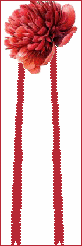
Peony – Peonies can live for hundreds of years if they are not disturbed, and the name comes from an ancient god among the Big Folk of Middle–earth when they did not know about the Valar. The god’s name was Paeon. You will sing praises if you take this lovely rosette home.
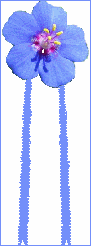
Pimpernel – No, we do not have scarlet ones. Why is everyone asking?
Primrose/ Primula – "first rose." It represents spring and first love. Buy thirteen or more for good luck! Only one brings bad luck. Folklore says children eating primroses can see fairies. Buy some in honor of Frodo’s late mother.

Rose – Roses represent love, passion, hope, and the mystery of life. They are also associated with Varda. Different kinds of roses are associated with different Big Folk. Buy one in honor of Sam Gamgee’s wife.

Wild rose – Big Folk like other roses, but we think this one fits the Shire the best. Roses represent both transient love and enduring love as well as secrecy, purity, and religious devotion.
We also have:
Apple blossom
Gillyflower
Lily
Lobelia
Pansy
Poppy
Snapdragon – a favorite in hobbit gardens
Sunflower – a favorite in hobbit gardens
If you aren't afraid of the big bad Old Forest, you’ll find some nice flowers. We received these designs from Goldberry.
Flag lily – lilies represent purity and are associated with Varda.
Water lily – represents pure hearts
For a little High Elven elegance, try these:


Elanor – "sun-star." Some say the flowers are like golden pimpernels. They are small, star–shaped flowers that grow on Cerin Amroth in Lothlórien. Elves brought these lovely flowers from Tol Eressëa, an island of the Undying Lands.

Mallorn – "golden tree." Mallorn trees have silver bark and pale green leaves that have silver undersides. The leaves turn golden in the fall and drop as soon as the flowers come. So in the spring and summer, groves are carpeted and roofed in gold while the bare trees stand like silver columns. The mallorn once flourished in sad Númenor of old, but now they survive in Lothlórien and the tree Sam planted in the Party Field. Take a bit of history with you today.

Niphredil – Said to be like snowdrop, they have white to pale green flowers that grow on Cerin Amroth in Lothlórien. We have made ours from drawings of elvish travelers, who say they once grew in the land of Doriath.

Simbelmynë – “Evermind.” Remember that special someone.
The garden of Gondor deserves a spot in our stand.
Broom blossoms – lovely and yellow. Some Big Folk have referred to it as “Planta genista.”
Heather – We have the usual purple and the rarer lucky white. Buy for someone who loves heather-flavored ale.
Iris – some Big Folk call it the “Flower–de–luce” or “fleur de Louis.” We have even heard some call it “fleur–de–lys.” The specific iris that has been called the “fleur–de–lys” is the flag iris. A king named Clovis was trapped in a river but was saved from drowning by flag irises, so he adopted them as his banner. With three petals, irises have been also associated with the spiritual. An ancient name for them is “gladdon.”
Parsley – also called “cow parsley” or “Queen Anne's lace.”
Sage/ Salvia – it’s believed to give longevity. Buy one and give it a try.
Allan, Jim. (2002, 1978). An Introduction to Elvish. Bath: Bath Press.
Daisy, History and Origin. (1998). A New Leaf Florist & Gifts. http://www.daisybooks.com/thehistoryofthedaisy.html.
Hazell, Dinah. (2008). The Plants of Middle–earth: Botany and sub–creation. Kent State University Press.
Plants and Trees. (2003-2011). The Thain's Book. http://www.tuckborough.net/plants.html
Wells, Diana. (1997). 100 Flowers and how they got their names. New York: Workman Publishing.
Public domain photos.
Notes :
If we got the elvish (Sindarin) wrong, we are hobbits!
Varda is a stand-in for the Virgin Mary.

